
Research
The main concerns with low-demand transitions are its macroeconomic consequences; think unemployment, inequality, deficits, monetary instabilityn. The defining approach of my PhD is to consider them not as separate obstacles but as facets of one process of directed structural change, constrained by ecological limits and by the requirement that needs be met.
Where this starts: ecological sufficiency
Keeping the 1.5° objective alive takes more than improving the efficiency of what we consume: rebound effects, technological lock-in and cost all get in the way. Sufficiency (that we broadly define as reducing the production and consumption of certain goods and services as a mitigation strategy) is the complementary approach. Research on it has largely asked three questions: what it looks like, whether it works, and how we get there.
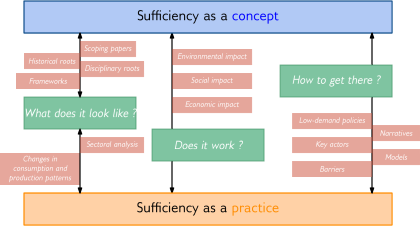
Figure 1: Sufficiency in the literature, a framework analysis
Most of that work sits at the microeconomic scale. The objections that actually structure political debate are macroeconomic !
Macroeconomic consequences are often evaluated at constant productive structure : a steady state is perturbed by an exogenous demand shock. They are however not independent: the sectoral, distributive and institutional composition of a transition determines its effects on employment, distribution, the budget and the external balance simultaneously.
Structure is more than sectoral shares
Economic structure here means the long-run configuration of several interdependent dimensions:
- Sectoral compositionWhat is produced, and the input-output links holding it together
- Industrial organisationFirm size, trade, geography, business models
- Technical changeIts direction and its intensity
- Employment structureEmployment level, wage, skills, working conditions
- DistributionIncome and wealth
- DemandLevel and composition
- InstitutionsRules governing access to resources, labour and finance
Low-demand affects several of these at once !
Some sectors shrink (fast fashion, aviation, intensive livestock), others expand (public transport, care, education, retrofitting, repair). They differ in energy intensity, productivity dynamics, capital intensity and trade exposure, so aggregate outcomes depend on which composition is realised. Change also happens within sectors: goods built to last, smaller firms, more repair and only looking at aggregates fails capturing that. Finally it produces winners and losers across households, regions and firms: a transition that is not guided by distribution (in all its understandings) either widens inequalities or misses its environmental target.
Looking at all these dimensions coherently raises key questions for low-demand transitions:
Do expanding sectors generate enough jobs to absorb the labour released by contracting ones? Do their productivity dynamics support a real wage consistent with meeting essential needs? Does their investment find financing compatible with the savings of the system? Does the public balance hold under an enlarged role for public financing?
And so many more interesting questions
Research projects
Economic structures for low-demand futures: a systematic mapping
- Systematic review
- First draft
- with Gabriele Dabbaghian
What the literature already says about the structural configurations compatible with low-demand futures and what it leaves unmapped.
Quality over Quantity: the macroeconomic impacts of product longevity as a sufficiency lever
- Stylised SFC model
- Under review
What happens to output, employment and incomes when goods are built to last, depending on what “quality” changes in terms of structural dynamics.
Sufficiency-enabling infrastructure and structural change under a carbon budget
- Multisector growth model
- First draft
Investigating sufficiency as enabling investment in an orthodox growth model. How the infrastructure that makes low-demand lifestyles possible competes for a finite carbon budget. Focus on sectoral prioritisation of investment.
Structural change through structural dependencies: a core-periphery model of sufficiency transitions
- Extended stylised IO
- Presented at ICEM 2026
- with Cyril Chavannat
How physical and monetary dependencies constrain the response of peripheral countries to sufficiency transitions in the core.
Occupational reallocation constraints in demand-side mitigation: French sufficiency pathways
- Agent-based model
- Vague idea
Whether workers released by contracting sectors can actually reach the expanding ones.
Side projects
Democratising the macroeconomic modelling toolbox
- Policy profile
- June 2026
- with Simone D'Alessandro and Matthieu Bordenave
Who gets to build, run and contest the models that frame economic policy.
D'Alessandro, S., Bordenave, M., & Rouge, K. (2026). “Policy Profile 6.4: Democratising the Macroeconomic Modelling Toolbox.” In The Roadmap for Eradicating Poverty Beyond Growth: Report of the Special Rapporteur on extreme poverty and human rights, Olivier De Schutter. New Economies Eradicating Poverty.
Penser la macroéconomie des transitions de sobriété comme un changement structurel
- Book chapter
- Forthcoming
The French statement of the framing above, for a law-and-sufficiency colloquium: legal instruments as structural components to coordinate, not an external frame.
Rouge, K. (2026). In B. Le Baut-Ferrarese, M. Moline-Dubost & L. Robert (Eds.), Le droit en toutes sobriétés. Forthcoming.
Stay tuned for updates on my research!