Modèle IS-LM II
TD Introduction à la macroéconomie
2025-05-06
Modèle IS-LM - Une approche plus macro
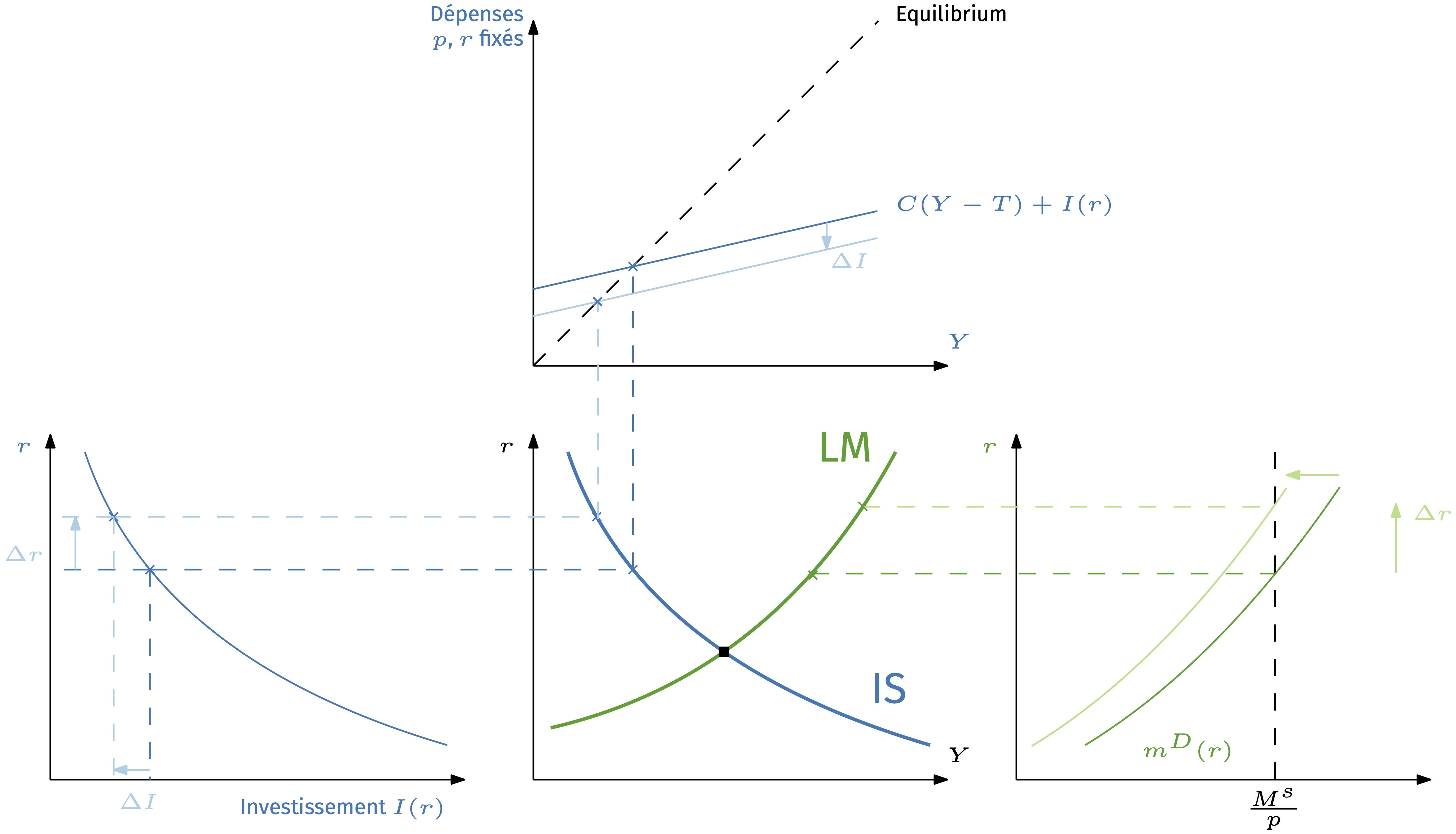
Modèle IS-LM
#| '!! shinylive warning !!': |
#|   shinylive does not work in self-contained HTML documents.
#|   Please set `embed-resources: false` in your metadata.
#| standalone: true
#| viewerHeight: 650
from shiny import App, ui, reactive, render_plot
import numpy as np
import matplotlib.pyplot as plt
from scipy.optimize import root_scalar

# -- Functional forms --
# CRRA utility: u(c) = c^(1-sigma)/(1-sigma) => u'(c) = c^(-sigma)
# Production in period 2: F2(K) = A2 * K^alpha2
# Investment condition: F2'(K) = alpha2 * A2 * K^(alpha2-1) = 1 + r  => K(r)
# Money demand: mD(Y,i) = Y / i   (real money demand)

alpha1, alpha2 = 0.7, 0.3
p1 = 1.0  # price level period 1

def marginal_util(c, sigma):
    return c**(-sigma)

def K_of_r(r, A2):
    # invert F2'(K)=1+r
    return ((1 + r) / (alpha2 * A2))**(1/(alpha2 - 1))

# IS: for a given Y, solve u'(c1) - beta*(1+r)*u'(c2) = 0, where c1=Y-K, c2=F2(K)
def compute_i_IS(Y, beta, A, A2, pi, sigma):
    def f_root(r):
        K = K_of_r(r, A2)
        c1 = Y - K
        c2 = A2 * K**alpha2
        return marginal_util(c1, sigma) - beta*(1+r)*marginal_util(c2, sigma)

    # find bracket [r_lo, r_hi] where f_root changes sign
    r_vals = np.linspace(-0.9, 10, 200)
    f_vals = [f_root(r) for r in r_vals]
    bracket = None
    for i in range(len(r_vals)-1):
        if f_vals[i] * f_vals[i+1] < 0:
            bracket = (r_vals[i], r_vals[i+1])
            break
    if bracket is None:
        # fallback to secant if no bracket found
        sol = root_scalar(f_root, x0=0.1, x1=1.0, method='secant', maxiter=100)
    else:
        sol = root_scalar(f_root, bracket=bracket, method='bisect', maxiter=100)
    r_star = sol.root
    return r_star + pi

# LM: solve M_s/p1 - Y/i = 0 => i = Y * p1 / M_s
def compute_i_LM(Y, M_s):
    return Y * p1 / M_s

# -- UI --
app_ui = ui.page_fluid(
    ui.h2("IS-LM with Exact Equations"),
    ui.layout_sidebar(
        ui.sidebar(
            ui.input_slider("A",    "Productivity A (F1 scale):",  min=0.5, max=2.0, value=1.0, step=0.1),
            ui.input_slider("A2",   "Optimism A2 (F2 scale):",     min=0.5, max=2.0, value=1.0, step=0.1),
            ui.input_slider("beta", "Discount β:",               min=0.1, max=1.0, value=0.98, step=0.01),
            ui.input_slider("sigma","CRRA σ:",                  min=0.5, max=5.0, value=2.0, step=0.1),
            ui.input_slider("Ms",   "Money Supply M^S:",         min=0.5, max=5.0, value=1.0, step=0.1),
            ui.input_slider("pi",   "Inflation π:",              min=0.0, max=0.5, value=0.02, step=0.01),
            ui.input_action_button("reset", "Reset Defaults")
        ),
        ui.card(
            ui.card_header("IS & LM Diagram"),
            ui.card_body(ui.output_plot("plot", height="600px"))
        )
    )
)

# -- Server --
def server(input, output, session):
    # store initial defaults
    DEFAULTS = {
        "A":    1.0,
        "A2":   1.0,
        "beta": 0.98,
        "sigma":2.0,
        "Ms":   1.0,
        "pi":   0.02
    }

    # reset sliders to initial defaults when button is pressed
    @reactive.event(input.reset)
    def _reset_inputs():
        for name, val in DEFAULTS.items():
            session.set_input_value(name, val)

    @output
    @render_plot()
    def plot():
        # Base parameters
        A0, A20, beta0, sigma0, Ms0, pi0 = 1.0, 1.0, 0.98, 2.0, 1.0, 0.02
        # Current
        A, A2, beta, sigma, Ms, pi = (
            input.A(), input.A2(), input.beta(), input.sigma(), input.Ms(), input.pi()
        )
        # Y grid
        Y = np.linspace(0.1, 10, 100)
        # Compute curves
        i_IS_base = [compute_i_IS(y, beta0, A0, A20, pi0, sigma0) for y in Y]
        i_LM_base = compute_i_LM(Y, Ms0)
        i_IS_cur  = [compute_i_IS(y, beta,  A,   A2,   pi,  sigma) for y in Y]
        i_LM_cur  = compute_i_LM(Y, Ms)

        # Equilibrium for current
        eq_diff = np.abs(np.array(i_IS_cur) - np.array(i_LM_cur))
        idx = eq_diff.argmin()
        Y_eq, i_eq = Y[idx], i_IS_cur[idx]

        # Plot
        fig, ax = plt.subplots(figsize=(8,6))
        # base curves
        ax.plot(Y, i_IS_base, '--', color='gray', alpha=0.5, label='IS (base)')
        ax.plot(Y, i_LM_base, '--', color='gray', alpha=0.5, label='LM (base)')
        # current curves
        ax.plot(Y, i_IS_cur, '-', color='crimson', label='IS (current)')
        ax.plot(Y, i_LM_cur, '-', color='navy', label='LM (current)')
        # equilibrium
        ax.plot(Y_eq, i_eq, 'ko')
        ax.axhline(i_eq, linestyle='--', color='black')
        ax.axvline(Y_eq, linestyle='--', color='black')
        ax.text(Y_eq, i_eq, f'  (Y*, i*)=({Y_eq:.2f},{i_eq:.2f})')

        ax.set_xlabel('Output Y')
        ax.set_ylabel('Interest rate i')
        ax.set_title('Exact IS-LM Curves')
        ax.legend()
        ax.grid(True)
        return fig

app = App(app_ui, server)